|
Electro-Optical Effect and Crystals
BBO, KTP,
KD*P, LN,
RTP crystals for
E-O
When an electric field (E)
is applied to an electro-optic (E-O) crystal, the refractive index of the crystal changes linearly to
the electric field. The phenomenon is called linear electro-optic effect. In KD*P crystal,
as an example, the change of the refractive index is Δn = 0.5no3γ63E
if both the light propagation and the electric field are along the
z-axis, where no is refractive index without electric field and
γ63
the
electro-optic coefficient of KD*P.
When
a linearly polarized light passes through an E-O crystal,
the phase retardation (Γ )
is induced by
Δn, i.e.
Γ = 2πΔnL/λ,
where
L is the crystal length, λ
the light wavelength. For KD*P, again as an example, the phase
retardation can be expressed
as Γ =
πLno3
γ63E/λ.
Apparently the phase of light changes with electric field
E. This is called E-O phase modulation. Further, if two polarizers with
orthogonal polarizations are placed at the input and output ends of an E-O crystal,
the output intensity of light will be I =
I0 sin2(Γ/2),
where I0 is
the input intensity. The intensity of light then can be modulated by electric
field. This is E-O amplitude modulation.
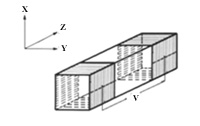
There are two types of E-O modulations,
(1) Longitudinal E-O modulation where the directions of electric field and light propagation are the
same. The KDP isomorphic crystals are normally used in this scheme.
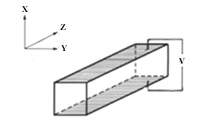
(2) Transverse E-O modulation where the
directions of electric field and light propagation are perpendicular to each
other. LiNbO3,
MgO:LiNbO3,
ZnO:LiNbO3, BBO and KTP crystals are usually employed in this scheme.
The half-wave voltage (Vπ) is
defined as the voltage at which the phase retardation
Γ = π.
For example, Vπ=λ/(2no3
γ63)
for KD*P and Vπ=λd/(2no3
γ22L)
for LiNbO3, where λ is light wavelength, d the distance between the
electrodes and L the crystal length.
BBO for EO
KD*P for EO
LiNbO3 for EO
KTP for EO
RTP for EO
|